Ceil
Defined in header <cmath>.
Description
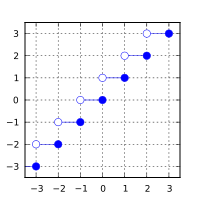
Computes the smallest integer value not less than num.
The library provides overloads of std::ceil for all cv-unqualified floating-point types as the type of the parameter num (od C++23).
Additional overloads are provided for all integer types, which are treated as double (od C++11).
Declarations
- C++23
- C++11
// 1)
constexpr /* floating-point-type */ ciel( /* floating-point-type */ num );
// 2)
constexpr float cielf( float num );
// 3)
constexpr long double ciell( long double num );
// 4)
template< class Integer >
constexpr double ciel ( Integer num );
// 1)
float ciel ( float num );
// 2)
double ciel ( double num );
//3)
long double ciel ( long double num );
// 4)
float erfcf( float num );
// 5)
long double erfcl( long double num );
// 6)
template< class Integer >
double ciel ( Integer num );
Parameters
num - floating point or integer value
Return value
If no errors occur, the smallest integer value not less than num, that is ⌈num⌉, is returned.
Error handling
Errors are reported as specified in math_errhandling.
If the implementation supports IEEE floating-point arithmetic (IEC 60559):
The current rounding mode has no effect.
If num is ±∞, it is returned unmodified
If num is ±0, it is returned, unmodified
If num is NaN, NaN is returned
Notes
FE_INEXACT may be (but is not required to be) raised when rounding a non-integer finite value.
The largest representable floating-point values are exact integers in all standard floating-point formats,
so this function never overflows on its own; however the result may overflow any integer type (including std::intmax_t),
when stored in an integer variable. It is for this reason that the return type is floating-point not integral.
This function (for double argument) behaves as if (except for the freedom to not raise FE_INEXACT) implemented by the following code:
#include <cfenv>
#include <cmath>

#pragma STDC FENV_ACCESS ON

double ceil(double x)
{
    int save_round = std::fegetround();
    std::fesetround(FE_UPWARD);
    double result = std::rint(x); // or std::nearbyint
    std::fesetround(save_round);
    return result;
}
The additional overloads are not required to be provided exactly as Additional Overloads.
They only need to be sufficient to ensure that for their argument num of integer type,
std::ceil(num) has the same effect as std::ceil(static_cast<double>(num)).
Examples
#include <cmath>
#include <iostream>

int main()
{
    std::cout
        << std::fixed
        << "ceil(+2.4) = "
        << std::ceil(+2.4) << '\n'
        << "ceil(-2.4) = "
        << std::ceil(-2.4) << '\n'
        << "ceil(-0.0) = "
        << std::ceil(-0.0) << '\n'
        << "ceil(-Inf) = "
        << std::ceil(-INFINITY) << '\n';
}
ceil(+2.4) = 3.000000
ceil(-2.4) = -2.000000
ceil(-0.0) = -0.000000
ceil(-Inf) = -inf